And yet again, a twofer, covering July and August's reading/listening.
Found Horizons
 The Fifth Season, by N.K. Jemisin
As a note, this is another of those books where I have no idea how most of the names are spelled. In this case, this actually masked a significant character note, switching a character's chosen name from Syenite - after a coarse, igneous rock - to Cyanite - a far more decorative blue silicate gemstone.
In a world of ceaseless, violent seismic activity, the Stillness is the only inhabitable land, and that with great difficulty. Long ago, humanity angered Father Earth, and now all life exists at the mercy of irregular 'seasons', when supervolcanoes, tsunamis and other upheavals destroy civilisations. The only civilisation to last is Yumenesce, which has harnessed the power of those 'cursed' with the power of orogeny, able to tap into the power of the Earth itself, to still and redirect the destructive energies, but despised as unnatural and treated as barely human assets of the state. The story follows three women, before and at the start of a season which begins with the deliberate destruction of Yumenesce: Damaya is a novice orogen, training at the Fulcrum. Syenite is a talented young orogen in service to the Fulcrum. Essun is an older former agent of the Fulcrum, living secretly until her children reveal themselves, and her husband kills their son and abducts their daughter. These stories unfold in parallels across time, as they and their companions uncover the secrets which underpin the survival, and ultimate destruction of Yumenesce, and perhaps the end of the world. For real this time.
That's a lot of text for a brief synopsis, and there's a lot to this book.
Spoilers follow.
As in many of the recent Found Horizon entries, it is set in a secondary world dominated by non-white races, and also features non-cishet characters and polyamory in a positive light.
Its structure is unusual, cutting between three internally linear narratives out of overall order, and featuring three protagonists who are ultimately revealed to be a single woman. I guess this is a spoiler, but not much of one, as it is a fairly obvious twist once you start getting the timeline straight. The novel also uses a very unusual second person voice in narrating Essun's story, which I'll be honest feels somewhat gimmicky and also means the book occasionally tells me that my daughter has been kidnapped and I am not okay with this!
Oh,yes; it's also a pretty bleak book, as you might expect from the end of the world. Like Black Leopard, Red Wolf, it begins with a dead child, and this one was apparently(1) murdered by his own father(2). As the narrative proceeds, we learn just how utter is the systematic abuse and persecution of the orogens, and Jemisin is unusually successful in presenting a world where those with power are downtrodden, with the orogen highly engaged in their own oppression, via the Fulcrum. Control over them is maintained by the Guardians, who are lauded as cunning heroes able to defeat an orogen through pure skill, but whose abilities are in fact far more horrible and unnatural than those of the 'monsters' they control. The rest of society isn't much cosier, with the population divided into 'use castes' which define them in strictly utilitarian terms which, while ordinarily just part of their names, have a material impact on whether they get kicked out of their self-sufficient walled communities when a Season comes. The Seasons may result from the spite of an angry Earth - or quite possibly from the long-ago careless detonation of the planet's moon - but the Stillness is a mundane hell of entirely human manufacture.
Wicked Fox, by Kat Cho
 My knowledge of Korean language and mythology is second only to my knowledge of Korean nomenclature and Korean-to-English transliteration, so what I said about the names in The Fifth Season, but more so.
Miyoung is a gumiho, a nine-tailed fox in human form who must consume the life energy of men to survive. She is only half gumiho, however, and her human side rebels at the need to kill, driving her to only feed from the worst humanity has to offer. But then she rescues fellow sexy teen Jihoon from a goblin(3) and, in the process, loses her 'fox bead', a mystical item which might be her soul, and the two of them find themselves hurled together at the heart of a cruel conspiracy of revenge.
At two-thirds high school romance and one-third supernatural thriller, Wicked Fox is rather more of the former than I'd prefer, which I suspect means more than I'm not the target audience than that the book is bad. As it is, my main complaint is that I kind of wanted the relationship between the two leads to focus more on their friendship, rather than romance. I also had very little patience with the relationship between Miyoung and her gumiho mother, which consisted mostly of Miyoung getting kicked to the curb for being reckless and rebellious, and accepting all the blame even when her mother's actions - although in many ways justified by revelations in the course of the narrative - have directly led to the mistakes that Miyoung makes.
There is also a kind of a subtext that a powerful woman can only find love by becoming weak, and I don't really like that.
So, yeah. It's an interesting read for a glimpse into another culture's mores, but it's not a series I'll be following up on any time soon(3).
New Novels
 Stan Lee's Alliances: A Trick of Light, by Kat Rosenfield, Luke Lieberman, Ryan Silbert and Stan Lee
Nia has grown up in total isolation, with only her father for company, only a series of virtual reality simulations to explore the world, and only the internet to meet other people. Cameron has grown up surrounded by people, but separated from them by the trauma of his fathr's disappearance years ago. His best friend Juaquo is growing increasingly disaffected in the wake of his mother's recent death. After Cameron is struck by lightning on Lake Erie, he discovers the ability to sense and control the interactions of electronic devices, which brings him into contact with Nia, and into conflict with a mysterious agency run by his father's ex-partner's daughter. Elsewhere, an alien is seeking the scientist who almost destroyed her hive-minded race.
Full disclosure: I would feel like a arse being too harsh on Stan Lee's final project. Also, I was completely unprepared to hear his intro for this, the opening volume of a planned ongoing series, so that coloured everything here.
That being said... damn, but Cameron is an old-fashioned superhero. His cyberkinesis is very now, but he is every inch the straight, white, cis-male nerd. This would probably bother me less if Nia - the more powerful of the two - wasn't so strongly defined by her relationship to him and to her father, and depicted as barely capable of maintaining her own identity without support, or if Cameron's Latinx bestie Juaquo didn't disappear for half the story until Cameron needs him, and then prove easily manipulated by the villains' power. It's not the only place where the novel suffers from an excess of conservatism. The chief villains are female but unfeminine, yet neither presented as being as immediately powerful or effectual as the male 2IC of the Sinister Government Agency(5).
The worldbuilding - a day after tomorrow America, with a human race on the brink of technological singularity, yet never more divided - is excellent, but the human stories are more than a little stock. Honestly, the superhero genre has advanced to the point where a new power set does not a character make. Nia and Juaquo are substantially more interesting than Cameron, but both end up strongly dependent and rather at the mercy of the villains' powers in a way that Cameron never is.
 Galaxy Outlaws: Missions 2-6, by J.S. Morin
Rolling on with Galaxy Outlaws (see my last post for some background on this one) and... Man; some stuff happens. Tanny struggles with ties to her mob family and her dependence on Marine Corps super-soldier drugs, Mmri tries to reclaim her lost honour - because alien warrior culture - and a series of mini-episodes explore the backstories of the crew.
I'm going to be honest, I'm pretty much treating this series as filler. It's not bad, but it's not going to set my world on fire any time soon. As with A Trick of Light, its world-building is probably its biggest strength. Magic and SF are often an odd mix, but honestly, sorcery is as good an excuse for faster than light travel as any, and the notion that the galaxy is scattered with 'Earthlike' planets that are not merely similar in composition and environment, but literally identical in size and continental formation, raises a whole lot of interesting questions. I just wish I had more confidence that the answers would be as interesting.
 Fright Forest, by Marcus Sedgwick
Terror Town, by Marcus Sedgwick
Creepy Caves, by Marcus Sedgwick
Okay; wrapping up Marcus Sedgwick's Elf Girl and Raven Boy series - more or less; I've now read all but the second volume - I read through the first volume - Fright Forest - followed by the fourth and fifth, Terror Town and Creepy Caves.
Elf Girl - not her real name - and Raven Boy - also not his real name - meet when their homes in the forest are destroyed by an ogre. With the aid of a slightly second-rate witch they elude a band of hungry trolls and discover that the destruction of their home is done at the behest of the Goblin King. They discover that they must find the Tears of the Moon and the Singing Sword to defeat him, and set off to do so.
Acquiring the Tears in Dread Desert, they proceed to Terror Town, a community under the shadow of the Goblin King's evil, where they uncover a civic traitor and get their hands on the Singing Sword, a blade which constantly performs terrible lounge numbers except when held by Raven Boy. Here they also find allies, in the form of the trolls, the lord of the town and his official wizard, and set out to confront the Goblin King himself in the Creepy Caves, and attempt to finally defeat his world-destroying ambitions.
Elf Girl and Raven Boy is a pretty fun adventure romp, with uplifting themes of friendship and hope at odds with some of Sedgwick's other work. It's a little repetitive for my tastes, but that would probably go down a storm with the target audience.
New Comics
 Giant Days - Vol. 9 & 10, by John Allison
The chronicles of life at Sheffield University reach the end of the second year for Esther, Susan and Daisy, with the dissolution of their household in the face of conflicting emotional committments. Susan is moving into a house with McGraw, Daisy is moving into a shed in a warehouse with Ingrid, and Esther is moving into the depths of a crisis. At this moment of destiny, a visit from Esther's erstwhile croney Sarah Grote and her younger sister, youthful mystery-solver Charlotte, pushes Daisy to break up with Ingrid, while Esther knuckles down to study - for real this time - and takes a room in a house with Ed Gemmell, whose long-standing crush on her can only spell a complication-free final year.
The third - and final, for everyone but medical student Susan - year begins with intense emotional turmoil, as Esther struggles to make amends to Ed for capitalising on his feelings to secure the best room, Susan and McGraw's domestic bliss encounters teething troubles, and Daisy's gran finds out that she hid her entire, turbulent relationship with Ingrid. The job fair brings opportunities, and consequent existential angst, and somewhere in amongst all this there is a suggestion that perhaps our heroes are going to... I think they're called 'lectures'.
 Volumes 9 and 10 of John Allison's campus epic Giant Days move us somewhat further than ever from the whole study thing, which is probably a good thing as there is probably only so much play there, and the domestic lives of our intrepid trio have drama a-plenty. The cameo from Bad Machinery's Charlotte Grote - technically, I think, a pre-Bad Machinery appearance - was also a delight to me, not just because BM is so much my jam, but because I always love seeing Lottie crash like a heavily-armoured and brutally-honest truth-wagon into the lives of complacent adults (a la the Shelley Winters one-shot Murder She Writes.)
Particular triumphs in this installement include Daisy's breakup with Ingrid, which effecitvely portrays the emotional rollercoaster of excising someone from your life who is incredibly toxic without having any malicious intent, and the fallout of Ed's incredibly drunken confession of his love for Esther, balancing Esther's unexpectedly self-aware reflection on the fact that she has always known that he loved her, just never wanted anything more than friendship, and Ed's mature realisation that he can't hold Esther accountable for his feelings.
I confess I was really worried about the Ed Gemmell dynamic early in the run, but my stars he's coming up a winner. I'm so happy to see the unrequited lover figure transcend the status of pathetic incel and show real growth. Esther also surprises once again, and again, I love the fact that wanting to be friends with someone you know had or has stronger feelings isn't a bad thing.
 By Night - Vol. 2, by John Allison
Something is wonky in the state of South Dakota, and in particular in the dying town of Spectrum. Jane, Heather and their allies - Heather's dad, Chip, Jane's co-worker Barney - have returned with usable footage of the other dimension, but Jane is upset that Heather dropped her in a vampire nest, and Barney is harbouring a secret that could ruin everything. Meanwhile, in the other dimension, Gardt the troll-type-thing is condemened by his peers for aiding the human interlopers, and banished to the holy mountain where he finds the long-lost Chet Charles, and a mysterious predator escapes to the real world.
Up front, I want to say that I am waiting with bated breath for the worlds of Tackleford/Sheffield and Spectrum to overlap.
Volume 2 of By Night does a lot of establishing backstory, after the basic world-building of volume 1, and takes us through four volumes of a dimension-hopping story without any of the main characters hopping dimensions. It's a far cry from the episodic adventures of Sheffield University's most eccentric students, but Allison's pacing is solid, his characters as appealing and his humour as sparkling as in his less serial fiction. Jane and Heather's friendship is real and affecting, Barney's flaws both infuriating and sympathetic, and Chip is as delightful a sports-obsessed resting alpha as you could hope to encounter.
In many ways, By Night is a step on a path from the early, gag of the day Bobbins strips, through the increasingly pronounced narrative arcs of SGR and Bad Machinery, to the long-form character arcs of Giant Days to a work telling essentially a single story over an extended period. With Giant Days approaching the inevitable armageddon of graduation, I'm happy with the idea that By Night is the future of Allison's writing, whether or not it all truly exists in a fully shared universe. I'm also very pleased to see a creator I have long admired making a living from his art.
Podcasts
 Tales from the Aletheian Society, Chapter 3
I've not done a lot of podcast reviews, but I finished a couple this month, so here we go.
Full disclosure, I actually know a bunch of people who are involved in the production of Tales from the Aletheian Society, which is how I came to find it in the first place. It's the serialised adventures of the members of the Glasgow Chapter of the titular organisation, a Victorian secret society devoted to battling the supernatural and riddled with vice, incompetence and apathy. Established under the dissolute leadership of Dr Hieronymus Cadwallader following the destruction of the previous chapter in and around 'the incident,' the Glasgow chapter muddle through one adventure, negotiate another under the oversight of Dr Cadwallader's ruthlessly driven aunt Cressida, bringing them to Chapter 3, and a clash with the Lovecraftian mathematics of Charles Babbage.
I won't drop many spoilers, since twists and turns are a hallmark of the series, alongside bawdy humour and surpising depths of character. It's an essentially amateur(6) production, supported largely by crowdfunding, but what it loses in forgiving production schedules and top-shelf foley work, it more than makes up in efficiency and independence - producing at least four times the content of a professional scripted podcast and presenting it without adverts - and there really isn't a big difference in acting or writing quality.
There are three seasons, so if the above sounds interesting and as long as you're reasonably comfortable with rough humour, give it a go.
 Wolverine: The Lost Trail
Richard 'Thorin' Armitage plays Wolverine in the sequel to last year's The Long Night, a moody, horror-tinged piece set during the character's wilderness years. Pursued by the Prime Sentinels of Weapon X and mutant hunters of all kinds, Wolverine tries to find his missing ex - a perennial plot for old Logan, of course - while seeking vengeance against the programme that created him and wrestling with the better angels of his nature which drive him to help those in need. The Lost Trail is set in New Orleans, and follows Logan's search for Maureen, a Weapon-X scientist who helped him to escape and who was his lover for a time. While looking, he encounters Marcus Baptiste, a young man whose mother and entire community have vanished, part of a series of disappearances which point to a place called Greenhaven, and a mutant named Jason Wyngarde.
Armitage is an intense, growling presence at the centre of the story - a departure from The Long Night, in which he was more of a catalyst than an actual character - while a strong supporting cast put forth a variety of Cajun accents(7). Marcus is the emotional core of the story, but Armitage plays Logan as a particularly ferocious lost puppy who needs to learn how and who to trust, and that keeps him from being too bland a centrepiece.
 Rachel Watches Star Trek
In 2017, podcaster and Star Trek fanatic Chris Lackey persuaded his Trek-skeptic wife, the eponymous Rachel, to watch the original series with him, and podcast her reactions as a new viewer, alongside his as he revisited episodes he might not have seen for some time. Episodes came out roughly once a month, with no definite promise that she would make it through the first series. Two years later, and episodes are coming out two or three times a month, alongside comment shows and other bonus content (including Chris Watches Musicals and analysis of episodes of other retro SF shows,) and Rachel regularly composes and performs songs and jingles dedicated to recurring Trek tropes. The final episode of season three, and of the original series as a whole, came out recently, and after a bit of series wrap-up the plan is to move on to the animated series.This is also one of two podcasts that I back financially.
I came to Rachel Watches Star Trek out of vague curiosity, but fell in love with the affectionate dissection of classic Trek. I think that what makes it work is that Rachel is not determined to hate Trek, and that Chris is not determined that she - or indeed he - must unequivocally love it. There is a pernicious idea in nerd-oriented media that a person must love the things you love for there to be a future in your relationship(8), which is unhealthy and unhelpful, so it's great to have something so nerdy in which this real-life couple put the lie to that bullshit. It's also fascinating to hear Rachel coming at Star Trek without all the accumulated baggage and trivia that I have in my head.
I don't know what you'd make of this if you didn't know Star Trek already, but as a fan - and having recently gone back into TOS on Netflix and noted some... troublesome aspects - it's utterly fascinating.
 Monster Man (and Patron Deities)
The other podcast that I back is Monster Man, in which my university buddy James Holloway analyses the monsters of 1st edition AD&D (although when he finishes Monster Manual II, he might need to swap editions.) This could be a fairly mechanical process, but James comes at this as a highly qualified historian, archaeologist and GM, so rather than just looking at numbers or poking fun at some of the weirder monsters, he looks at their history within the game, their antecedents in real world literature and mythology, and at their potential uses as more than just dungeon filler. It's a process that has contributed more than a little to the homebrew setting for my own D&D game.
For Patreon backers like me, James also produces a companion series called Patron Deities, in which he is examining the Deities and Demigods supplement, analysing not only the presentation of the various real world deities within, but also the role of religuion and mythology within games more generally. Again, this has been a big influence on my setting.
Monster Man is both entertaining and a useful resource for anyone looking at creating a more coherent fantasy setting.
Re-reads
 Coraline, by Neil Gaiman
Coraline lives with her mother and father in one of three flats in an old house. They have only lately moved and their neighbours are eccentric, leaving Coraline a little lost, especially as her parents have less time for her than she would like and her father is the world's most experimental chef. It is a relief then to find a way into an alternative world, where a button-eyed 'Other Mother' offers her the life she has always thought she would like. But is the life you want as good as you thought? Is it really better than the life you have? And is a woman with buttons for eyes and hands like needles really someone with your best interests at heart?
A midget gem from the ever-prolific Gaiman, Coraline is a novelette full of creeping existential dread and body horror, but y'know; for kids. Widely and justly considered one of Gaiman's masterpieces, it encompasses some of the darkness of The Ocean at the End of the Lane, but also hope and love and strength, and features at its core a girl who is part of a perfectly normal family. Coraline's parents are not cruel or neglectful, but operate at a highly relatable remove from the needs of a daughter who is not quote a little girl anymore.
You know, I still haven't seen the film adaptation. I should probably do something about that.
 Stardust, by Neil Gaiman and Charles Vess
Speaking of Neil Gaiman, film adaptations and the like, the most recent novel I read to my partner at bedtime was Stardust.
Tristan Thorn is the son of a down to earth family in the not-entirely-down to earth village of Wall, a community that lies on the border of Faerie. When he sets out to return a falling star to the girl that he loves, Tristan puts his foot on a road which will bring him into a much larger quest, involving Lords of Faerie, Witch-Queens, and a luminous girl named Yvain, and lead him in the end to the fulfilment, not of his stated goal, but of his heart's desire.
Another of Gaiman's most popular works, Stardust was originally conceived as an illustrated work, with the images provided by Vess intended as an integral part of the text. It's a gorgeous production - it always feels a bit of a let-down to have it in paperback - and a compelling story, combining classic fairy tale tropes with a more modern narrative sensibility. Those who started with the movie sometimes have issues with the slightly more downbeat tone of the novel, which aims less for slapstick adventure than for melancholic romance, and in particular of the ending, but I've been a fan of it since before it was even optioned, and keep the original ending alongside The Little Mermaid on my very limited list of beautiful downers that I love anyway.
 I Was a Rat, by Philip Pullman
Roger seems like a normal boy, apart from his tendency to gnaw on things, the vagueness of his past memories, his insistence that he knows the beautiful lady who has lately married the handsome prince, and the fact that he insists that he used to be a rat. Bob and Joan take him in and try to do right by him, but a parade of showmen, criminals and journalists see a freak or a monster to be exploited, reviled or destroyed. Will a terrible (potential) killer be put to death? Or will an innocent boy be saved by the unassailable goodness of a princess?
I Was a Rat is one of a number of children's books written Philip Pullman in the wilderness years before His Dark Materials made him a controversial titan of the young adult scene. It's a social satire with a quasi-Victorian setting, and if the freakshow itself isn't much of a hard target these days, the abuse of the young, the apathy of institutional education, and the malignancy of the sensationalist press are evergreen. The links to the Cinderella story of course serve to make the whole thing more relevant to a younger audience - this was one that I read with my daughter - and the whole is both satisfying nad accessible.
(1) I mean... probably actually. I live in hope.
(2) In review terms, the fact that I got through this opening to the rest of the novel, albeit on the third time of trying, is pretty telling of the overall quality.
(3) A dokebi (spelling almost certainly wrong,) which seems to be kind of a homonculus, created either to gather wealth or to be a sexy sidekick, depending on the individual.
(4) I mean, whatch this space for when I even get around to the sequels to books that I really enjoyed.
(5) Again, full disclosure, I've forgotten most of the actual names in this novel, which is perhaps telling.
(6) I think. I'm not privvy to the contract details, but it certainly isn't a big commercial gig.
(7) Yes; Gambit is in there.
(8) YouTube keeps showing me clips from How I Met Your Mother in which an otherwise promising relationship is scuppered because she doesn't care for Star Wars, just as an example.
Found Horizons

As a note, this is another of those books where I have no idea how most of the names are spelled. In this case, this actually masked a significant character note, switching a character's chosen name from Syenite - after a coarse, igneous rock - to Cyanite - a far more decorative blue silicate gemstone.
In a world of ceaseless, violent seismic activity, the Stillness is the only inhabitable land, and that with great difficulty. Long ago, humanity angered Father Earth, and now all life exists at the mercy of irregular 'seasons', when supervolcanoes, tsunamis and other upheavals destroy civilisations. The only civilisation to last is Yumenesce, which has harnessed the power of those 'cursed' with the power of orogeny, able to tap into the power of the Earth itself, to still and redirect the destructive energies, but despised as unnatural and treated as barely human assets of the state. The story follows three women, before and at the start of a season which begins with the deliberate destruction of Yumenesce: Damaya is a novice orogen, training at the Fulcrum. Syenite is a talented young orogen in service to the Fulcrum. Essun is an older former agent of the Fulcrum, living secretly until her children reveal themselves, and her husband kills their son and abducts their daughter. These stories unfold in parallels across time, as they and their companions uncover the secrets which underpin the survival, and ultimate destruction of Yumenesce, and perhaps the end of the world. For real this time.
That's a lot of text for a brief synopsis, and there's a lot to this book.
Spoilers follow.
As in many of the recent Found Horizon entries, it is set in a secondary world dominated by non-white races, and also features non-cishet characters and polyamory in a positive light.
Its structure is unusual, cutting between three internally linear narratives out of overall order, and featuring three protagonists who are ultimately revealed to be a single woman. I guess this is a spoiler, but not much of one, as it is a fairly obvious twist once you start getting the timeline straight. The novel also uses a very unusual second person voice in narrating Essun's story, which I'll be honest feels somewhat gimmicky and also means the book occasionally tells me that my daughter has been kidnapped and I am not okay with this!
Oh,yes; it's also a pretty bleak book, as you might expect from the end of the world. Like Black Leopard, Red Wolf, it begins with a dead child, and this one was apparently(1) murdered by his own father(2). As the narrative proceeds, we learn just how utter is the systematic abuse and persecution of the orogens, and Jemisin is unusually successful in presenting a world where those with power are downtrodden, with the orogen highly engaged in their own oppression, via the Fulcrum. Control over them is maintained by the Guardians, who are lauded as cunning heroes able to defeat an orogen through pure skill, but whose abilities are in fact far more horrible and unnatural than those of the 'monsters' they control. The rest of society isn't much cosier, with the population divided into 'use castes' which define them in strictly utilitarian terms which, while ordinarily just part of their names, have a material impact on whether they get kicked out of their self-sufficient walled communities when a Season comes. The Seasons may result from the spite of an angry Earth - or quite possibly from the long-ago careless detonation of the planet's moon - but the Stillness is a mundane hell of entirely human manufacture.
Wicked Fox, by Kat Cho
 My knowledge of Korean language and mythology is second only to my knowledge of Korean nomenclature and Korean-to-English transliteration, so what I said about the names in The Fifth Season, but more so.
Miyoung is a gumiho, a nine-tailed fox in human form who must consume the life energy of men to survive. She is only half gumiho, however, and her human side rebels at the need to kill, driving her to only feed from the worst humanity has to offer. But then she rescues fellow sexy teen Jihoon from a goblin(3) and, in the process, loses her 'fox bead', a mystical item which might be her soul, and the two of them find themselves hurled together at the heart of a cruel conspiracy of revenge.
At two-thirds high school romance and one-third supernatural thriller, Wicked Fox is rather more of the former than I'd prefer, which I suspect means more than I'm not the target audience than that the book is bad. As it is, my main complaint is that I kind of wanted the relationship between the two leads to focus more on their friendship, rather than romance. I also had very little patience with the relationship between Miyoung and her gumiho mother, which consisted mostly of Miyoung getting kicked to the curb for being reckless and rebellious, and accepting all the blame even when her mother's actions - although in many ways justified by revelations in the course of the narrative - have directly led to the mistakes that Miyoung makes.
There is also a kind of a subtext that a powerful woman can only find love by becoming weak, and I don't really like that.
So, yeah. It's an interesting read for a glimpse into another culture's mores, but it's not a series I'll be following up on any time soon(3).
New Novels

Nia has grown up in total isolation, with only her father for company, only a series of virtual reality simulations to explore the world, and only the internet to meet other people. Cameron has grown up surrounded by people, but separated from them by the trauma of his fathr's disappearance years ago. His best friend Juaquo is growing increasingly disaffected in the wake of his mother's recent death. After Cameron is struck by lightning on Lake Erie, he discovers the ability to sense and control the interactions of electronic devices, which brings him into contact with Nia, and into conflict with a mysterious agency run by his father's ex-partner's daughter. Elsewhere, an alien is seeking the scientist who almost destroyed her hive-minded race.
Full disclosure: I would feel like a arse being too harsh on Stan Lee's final project. Also, I was completely unprepared to hear his intro for this, the opening volume of a planned ongoing series, so that coloured everything here.
That being said... damn, but Cameron is an old-fashioned superhero. His cyberkinesis is very now, but he is every inch the straight, white, cis-male nerd. This would probably bother me less if Nia - the more powerful of the two - wasn't so strongly defined by her relationship to him and to her father, and depicted as barely capable of maintaining her own identity without support, or if Cameron's Latinx bestie Juaquo didn't disappear for half the story until Cameron needs him, and then prove easily manipulated by the villains' power. It's not the only place where the novel suffers from an excess of conservatism. The chief villains are female but unfeminine, yet neither presented as being as immediately powerful or effectual as the male 2IC of the Sinister Government Agency(5).
The worldbuilding - a day after tomorrow America, with a human race on the brink of technological singularity, yet never more divided - is excellent, but the human stories are more than a little stock. Honestly, the superhero genre has advanced to the point where a new power set does not a character make. Nia and Juaquo are substantially more interesting than Cameron, but both end up strongly dependent and rather at the mercy of the villains' powers in a way that Cameron never is.
Galaxy Outlaws: Missions 2-6, by J.S. MorinRolling on with Galaxy Outlaws (see my last post for some background on this one) and... Man; some stuff happens. Tanny struggles with ties to her mob family and her dependence on Marine Corps super-soldier drugs, Mmri tries to reclaim her lost honour - because alien warrior culture - and a series of mini-episodes explore the backstories of the crew.
I'm going to be honest, I'm pretty much treating this series as filler. It's not bad, but it's not going to set my world on fire any time soon. As with A Trick of Light, its world-building is probably its biggest strength. Magic and SF are often an odd mix, but honestly, sorcery is as good an excuse for faster than light travel as any, and the notion that the galaxy is scattered with 'Earthlike' planets that are not merely similar in composition and environment, but literally identical in size and continental formation, raises a whole lot of interesting questions. I just wish I had more confidence that the answers would be as interesting.
 Fright Forest, by Marcus Sedgwick
Terror Town, by Marcus Sedgwick
Creepy Caves, by Marcus Sedgwick
Okay; wrapping up Marcus Sedgwick's Elf Girl and Raven Boy series - more or less; I've now read all but the second volume - I read through the first volume - Fright Forest - followed by the fourth and fifth, Terror Town and Creepy Caves.
Elf Girl - not her real name - and Raven Boy - also not his real name - meet when their homes in the forest are destroyed by an ogre. With the aid of a slightly second-rate witch they elude a band of hungry trolls and discover that the destruction of their home is done at the behest of the Goblin King. They discover that they must find the Tears of the Moon and the Singing Sword to defeat him, and set off to do so.
Acquiring the Tears in Dread Desert, they proceed to Terror Town, a community under the shadow of the Goblin King's evil, where they uncover a civic traitor and get their hands on the Singing Sword, a blade which constantly performs terrible lounge numbers except when held by Raven Boy. Here they also find allies, in the form of the trolls, the lord of the town and his official wizard, and set out to confront the Goblin King himself in the Creepy Caves, and attempt to finally defeat his world-destroying ambitions.
Elf Girl and Raven Boy is a pretty fun adventure romp, with uplifting themes of friendship and hope at odds with some of Sedgwick's other work. It's a little repetitive for my tastes, but that would probably go down a storm with the target audience.
New Comics

The chronicles of life at Sheffield University reach the end of the second year for Esther, Susan and Daisy, with the dissolution of their household in the face of conflicting emotional committments. Susan is moving into a house with McGraw, Daisy is moving into a shed in a warehouse with Ingrid, and Esther is moving into the depths of a crisis. At this moment of destiny, a visit from Esther's erstwhile croney Sarah Grote and her younger sister, youthful mystery-solver Charlotte, pushes Daisy to break up with Ingrid, while Esther knuckles down to study - for real this time - and takes a room in a house with Ed Gemmell, whose long-standing crush on her can only spell a complication-free final year.
The third - and final, for everyone but medical student Susan - year begins with intense emotional turmoil, as Esther struggles to make amends to Ed for capitalising on his feelings to secure the best room, Susan and McGraw's domestic bliss encounters teething troubles, and Daisy's gran finds out that she hid her entire, turbulent relationship with Ingrid. The job fair brings opportunities, and consequent existential angst, and somewhere in amongst all this there is a suggestion that perhaps our heroes are going to... I think they're called 'lectures'.
Particular triumphs in this installement include Daisy's breakup with Ingrid, which effecitvely portrays the emotional rollercoaster of excising someone from your life who is incredibly toxic without having any malicious intent, and the fallout of Ed's incredibly drunken confession of his love for Esther, balancing Esther's unexpectedly self-aware reflection on the fact that she has always known that he loved her, just never wanted anything more than friendship, and Ed's mature realisation that he can't hold Esther accountable for his feelings.
I confess I was really worried about the Ed Gemmell dynamic early in the run, but my stars he's coming up a winner. I'm so happy to see the unrequited lover figure transcend the status of pathetic incel and show real growth. Esther also surprises once again, and again, I love the fact that wanting to be friends with someone you know had or has stronger feelings isn't a bad thing.
 By Night - Vol. 2, by John Allison
Something is wonky in the state of South Dakota, and in particular in the dying town of Spectrum. Jane, Heather and their allies - Heather's dad, Chip, Jane's co-worker Barney - have returned with usable footage of the other dimension, but Jane is upset that Heather dropped her in a vampire nest, and Barney is harbouring a secret that could ruin everything. Meanwhile, in the other dimension, Gardt the troll-type-thing is condemened by his peers for aiding the human interlopers, and banished to the holy mountain where he finds the long-lost Chet Charles, and a mysterious predator escapes to the real world.
Up front, I want to say that I am waiting with bated breath for the worlds of Tackleford/Sheffield and Spectrum to overlap.
Volume 2 of By Night does a lot of establishing backstory, after the basic world-building of volume 1, and takes us through four volumes of a dimension-hopping story without any of the main characters hopping dimensions. It's a far cry from the episodic adventures of Sheffield University's most eccentric students, but Allison's pacing is solid, his characters as appealing and his humour as sparkling as in his less serial fiction. Jane and Heather's friendship is real and affecting, Barney's flaws both infuriating and sympathetic, and Chip is as delightful a sports-obsessed resting alpha as you could hope to encounter.
In many ways, By Night is a step on a path from the early, gag of the day Bobbins strips, through the increasingly pronounced narrative arcs of SGR and Bad Machinery, to the long-form character arcs of Giant Days to a work telling essentially a single story over an extended period. With Giant Days approaching the inevitable armageddon of graduation, I'm happy with the idea that By Night is the future of Allison's writing, whether or not it all truly exists in a fully shared universe. I'm also very pleased to see a creator I have long admired making a living from his art.
Podcasts
 Tales from the Aletheian Society, Chapter 3
I've not done a lot of podcast reviews, but I finished a couple this month, so here we go.
Full disclosure, I actually know a bunch of people who are involved in the production of Tales from the Aletheian Society, which is how I came to find it in the first place. It's the serialised adventures of the members of the Glasgow Chapter of the titular organisation, a Victorian secret society devoted to battling the supernatural and riddled with vice, incompetence and apathy. Established under the dissolute leadership of Dr Hieronymus Cadwallader following the destruction of the previous chapter in and around 'the incident,' the Glasgow chapter muddle through one adventure, negotiate another under the oversight of Dr Cadwallader's ruthlessly driven aunt Cressida, bringing them to Chapter 3, and a clash with the Lovecraftian mathematics of Charles Babbage.
I won't drop many spoilers, since twists and turns are a hallmark of the series, alongside bawdy humour and surpising depths of character. It's an essentially amateur(6) production, supported largely by crowdfunding, but what it loses in forgiving production schedules and top-shelf foley work, it more than makes up in efficiency and independence - producing at least four times the content of a professional scripted podcast and presenting it without adverts - and there really isn't a big difference in acting or writing quality.
There are three seasons, so if the above sounds interesting and as long as you're reasonably comfortable with rough humour, give it a go.
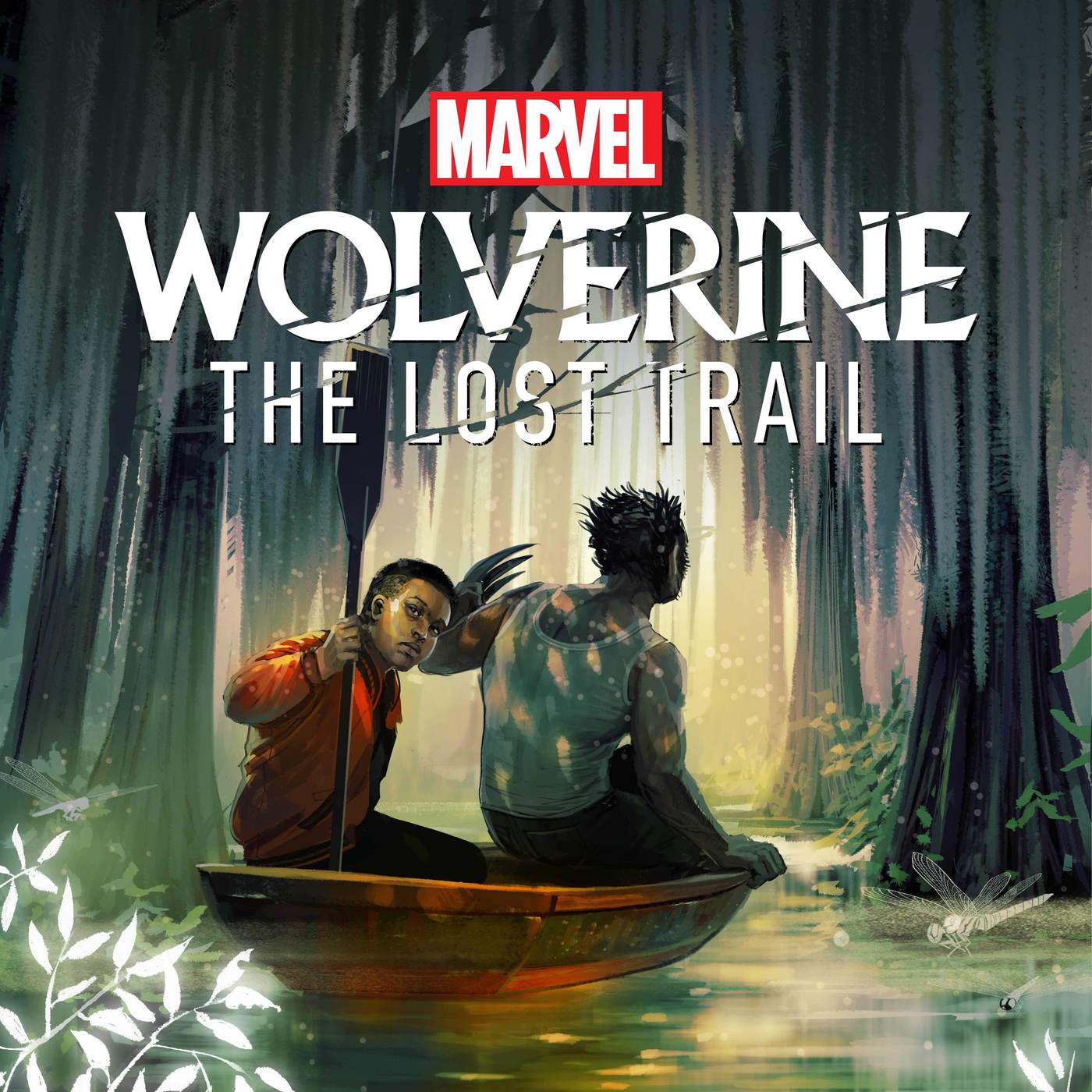
Richard 'Thorin' Armitage plays Wolverine in the sequel to last year's The Long Night, a moody, horror-tinged piece set during the character's wilderness years. Pursued by the Prime Sentinels of Weapon X and mutant hunters of all kinds, Wolverine tries to find his missing ex - a perennial plot for old Logan, of course - while seeking vengeance against the programme that created him and wrestling with the better angels of his nature which drive him to help those in need. The Lost Trail is set in New Orleans, and follows Logan's search for Maureen, a Weapon-X scientist who helped him to escape and who was his lover for a time. While looking, he encounters Marcus Baptiste, a young man whose mother and entire community have vanished, part of a series of disappearances which point to a place called Greenhaven, and a mutant named Jason Wyngarde.
Armitage is an intense, growling presence at the centre of the story - a departure from The Long Night, in which he was more of a catalyst than an actual character - while a strong supporting cast put forth a variety of Cajun accents(7). Marcus is the emotional core of the story, but Armitage plays Logan as a particularly ferocious lost puppy who needs to learn how and who to trust, and that keeps him from being too bland a centrepiece.

In 2017, podcaster and Star Trek fanatic Chris Lackey persuaded his Trek-skeptic wife, the eponymous Rachel, to watch the original series with him, and podcast her reactions as a new viewer, alongside his as he revisited episodes he might not have seen for some time. Episodes came out roughly once a month, with no definite promise that she would make it through the first series. Two years later, and episodes are coming out two or three times a month, alongside comment shows and other bonus content (including Chris Watches Musicals and analysis of episodes of other retro SF shows,) and Rachel regularly composes and performs songs and jingles dedicated to recurring Trek tropes. The final episode of season three, and of the original series as a whole, came out recently, and after a bit of series wrap-up the plan is to move on to the animated series.This is also one of two podcasts that I back financially.
I came to Rachel Watches Star Trek out of vague curiosity, but fell in love with the affectionate dissection of classic Trek. I think that what makes it work is that Rachel is not determined to hate Trek, and that Chris is not determined that she - or indeed he - must unequivocally love it. There is a pernicious idea in nerd-oriented media that a person must love the things you love for there to be a future in your relationship(8), which is unhealthy and unhelpful, so it's great to have something so nerdy in which this real-life couple put the lie to that bullshit. It's also fascinating to hear Rachel coming at Star Trek without all the accumulated baggage and trivia that I have in my head.
I don't know what you'd make of this if you didn't know Star Trek already, but as a fan - and having recently gone back into TOS on Netflix and noted some... troublesome aspects - it's utterly fascinating.

The other podcast that I back is Monster Man, in which my university buddy James Holloway analyses the monsters of 1st edition AD&D (although when he finishes Monster Manual II, he might need to swap editions.) This could be a fairly mechanical process, but James comes at this as a highly qualified historian, archaeologist and GM, so rather than just looking at numbers or poking fun at some of the weirder monsters, he looks at their history within the game, their antecedents in real world literature and mythology, and at their potential uses as more than just dungeon filler. It's a process that has contributed more than a little to the homebrew setting for my own D&D game.
For Patreon backers like me, James also produces a companion series called Patron Deities, in which he is examining the Deities and Demigods supplement, analysing not only the presentation of the various real world deities within, but also the role of religuion and mythology within games more generally. Again, this has been a big influence on my setting.
Monster Man is both entertaining and a useful resource for anyone looking at creating a more coherent fantasy setting.
Re-reads
 Coraline, by Neil Gaiman
Coraline lives with her mother and father in one of three flats in an old house. They have only lately moved and their neighbours are eccentric, leaving Coraline a little lost, especially as her parents have less time for her than she would like and her father is the world's most experimental chef. It is a relief then to find a way into an alternative world, where a button-eyed 'Other Mother' offers her the life she has always thought she would like. But is the life you want as good as you thought? Is it really better than the life you have? And is a woman with buttons for eyes and hands like needles really someone with your best interests at heart?
A midget gem from the ever-prolific Gaiman, Coraline is a novelette full of creeping existential dread and body horror, but y'know; for kids. Widely and justly considered one of Gaiman's masterpieces, it encompasses some of the darkness of The Ocean at the End of the Lane, but also hope and love and strength, and features at its core a girl who is part of a perfectly normal family. Coraline's parents are not cruel or neglectful, but operate at a highly relatable remove from the needs of a daughter who is not quote a little girl anymore.
You know, I still haven't seen the film adaptation. I should probably do something about that.
 Stardust, by Neil Gaiman and Charles Vess
Speaking of Neil Gaiman, film adaptations and the like, the most recent novel I read to my partner at bedtime was Stardust.
Tristan Thorn is the son of a down to earth family in the not-entirely-down to earth village of Wall, a community that lies on the border of Faerie. When he sets out to return a falling star to the girl that he loves, Tristan puts his foot on a road which will bring him into a much larger quest, involving Lords of Faerie, Witch-Queens, and a luminous girl named Yvain, and lead him in the end to the fulfilment, not of his stated goal, but of his heart's desire.
Another of Gaiman's most popular works, Stardust was originally conceived as an illustrated work, with the images provided by Vess intended as an integral part of the text. It's a gorgeous production - it always feels a bit of a let-down to have it in paperback - and a compelling story, combining classic fairy tale tropes with a more modern narrative sensibility. Those who started with the movie sometimes have issues with the slightly more downbeat tone of the novel, which aims less for slapstick adventure than for melancholic romance, and in particular of the ending, but I've been a fan of it since before it was even optioned, and keep the original ending alongside The Little Mermaid on my very limited list of beautiful downers that I love anyway.

Roger seems like a normal boy, apart from his tendency to gnaw on things, the vagueness of his past memories, his insistence that he knows the beautiful lady who has lately married the handsome prince, and the fact that he insists that he used to be a rat. Bob and Joan take him in and try to do right by him, but a parade of showmen, criminals and journalists see a freak or a monster to be exploited, reviled or destroyed. Will a terrible (potential) killer be put to death? Or will an innocent boy be saved by the unassailable goodness of a princess?
I Was a Rat is one of a number of children's books written Philip Pullman in the wilderness years before His Dark Materials made him a controversial titan of the young adult scene. It's a social satire with a quasi-Victorian setting, and if the freakshow itself isn't much of a hard target these days, the abuse of the young, the apathy of institutional education, and the malignancy of the sensationalist press are evergreen. The links to the Cinderella story of course serve to make the whole thing more relevant to a younger audience - this was one that I read with my daughter - and the whole is both satisfying nad accessible.
(1) I mean... probably actually. I live in hope.
(2) In review terms, the fact that I got through this opening to the rest of the novel, albeit on the third time of trying, is pretty telling of the overall quality.
(3) A dokebi (spelling almost certainly wrong,) which seems to be kind of a homonculus, created either to gather wealth or to be a sexy sidekick, depending on the individual.
(4) I mean, whatch this space for when I even get around to the sequels to books that I really enjoyed.
(5) Again, full disclosure, I've forgotten most of the actual names in this novel, which is perhaps telling.
(6) I think. I'm not privvy to the contract details, but it certainly isn't a big commercial gig.
(7) Yes; Gambit is in there.
(8) YouTube keeps showing me clips from How I Met Your Mother in which an otherwise promising relationship is scuppered because she doesn't care for Star Wars, just as an example.


