Thursday, 22 June 2017

2017 Reading Challenge - Balzac and the Little Chinese Seamstress

Book 8 (April, China)
 
Balzac and the Little Chinese Seamstress by Dai Sijie (read by B.D. Wong)

Reason for Reading: I picked this one for much the same reason as Wild Swans. It's a semi-autobiographical novella, rather than an actual biography, and also short, which is a mercy since I'm still on April's books at the moment. In some ways it's a bit of a cheat, as I've already seen the author's later film adaptation of the story.

If I have a regret about choosing Balzac and the Little Chinese Seamstress, it's that it is so similar in setting to Wild Swans, or at least to the section about Jung Chang's re-education. Following the experience of two boys sent into the mountains of Sichuan from Chengdu, the tales of carrying wicker baskets of shit up treacherous mountain paths were very familiar. Where they diverge, however, is in the characters and the focus. Jung Chang was giving a factual account, as best she could, while Dai Sijie is writing a story of doomed romance and the loss of innocence.

The unnamed narrator and his friend Luo are sent to the mountains to learn from the peasants. Luo is quickly established as a silver-tongued devil when he convinces the village headman to let his friend keep his violin - a 'bourgeois toy' - in order to play the Mozart sonata 'Mozart is thinking of Chairman Mao'(1). The children of disgraced medical 'experts', they fall in with a writers' son named Four-Eyes(2), whom they realise has somehow managed to smuggle a suitcase full of books up the mountain. When his mother gets him a job in the city(3), they steal the case and its wealth of translated French classics, reading them to the Little Seamstress, a beautiful young woman of whom they are both enamoured. It is Luo's affections that are reciprocated, but ultimately his desire to 'civilise' the mountain girl backfire, and she leaves her village to start a new life in the city.

Balzac and the Little Chinese Seamstress is a short novel, in which nothing much happens. There is only one point where the boys almost fall foul of the Cultural Revolution, and a number of instances which in a more melodramatic work would lead to danger or conflict are gently subverted, as when the narrator and Luo inscribe and sign favourite books as gifts to one another without this ever being used as evidence against them. BD Wong reads with a perfect intonation, shifting from the strident tones of the headman to the warm, plausible voice of Luo.

I'm not sorry to have chosen this novel, but it does fail in expanding my horizons beyond anything in Wild Swans.

(1) Sadly, as the book ends more abruptly than the film, we don't get the delightful scene where Ma (as the narrator character is named) meets the headman after the revolution and learns that he knew exactly what they were up to; he just liked the music.
(2) Luo is practically the only character with a real name.
(3) It is interesting that the semi-antagonist Four-Eyes is the character most like Jung Chang's description of herself.

Saturday, 17 June 2017

2017 Challenge - Wild Swans

Book 7 (April, China)

Wild Swans, by Jung Chang (read by Pik-sen Lim)

Reason for Reading: China found its way onto my theme list thanks in large part to The Three-Body Problem, which features some early scenes from the Cultural Revolution, a period of which I know very little. Wild Swans was pretty much a shoe in.

Wild Swans is - as you are probably aware even if you haven't actually read it - the semi-autobiography of author Jung Chang, her mother and her grandmother. It begins with her grandmother Yu Fang's excruciating foot binding, and her marriage to a Warlord General in pursuance of her father's career. As the Second Sino-Japanese and Second World Wars give way to continuing civil war between the Communists and the Kuomintang, Jung Chang's mother Bao Qin (alternatively De-hong) becomes a Communist spy, and later marries Communist official Wang Yu (or Shou-yu) and becomes an official herself, working in education. The family then live through the Cultural Revolution, where Jung's parents find themselves at odds with the collapse of the old party system into the cult of Mao, and Jung herself grows up a natural academic in a country that despises education.

Reading Wild Swans is an eye-opener. We tend to assume we have a good working knowledge of 20th century history, but the fact is that there is a huge amount of the world that we learn fuck all about in school. The Japanese occupation of northern China and the Cultural Revolution are things that I know happened, but most of the details were new to me. Wild Swans is a fascinating and disturbing look into a historical period that has a worrying number of parallels with a modern world where political and economic realities take second place to cults of personality, and political opponents are dogged and harassed by allies in the press or vilified for daring to question a great leader.

Thursday, 8 June 2017

Reading Roundup - Mostly May 2017

So, it has been a terrible month for reading. To get even one proper book I've had to extend into early June. There are several reasons for this:
  1. I've spent a lot of time not just commuting in and out, either being off sick or taking days for childcare or gaming, which means I lose about 2.5 hours of listening time per day.
  2. My current Challenge book is Wild Swans, which is dense AF and I can't do it justice if I'm half out of it.
  3. I lost a gang of listening time to Gladiator (Volume 1 of Wolf's Empire,) which was ultimately so meh I haven't managed to finish it.
That being said…

Saga is an ongoing series by Brian K. Vaughan and Fiona Staples about – more or less – the child of a pair of star-crossed lovers, one from either side of a techno-magical space war, and the various forces that want to eliminate/aid/capture them all. I came to it via Wil Wheaton's use of the character Lying Cat to respond to statements from the Trump administration. Volume 1 features the birth of our neonatal lead, a cadre of genuine ghosts putting the Scooby Doo on invaders, a spaceship grown from wood, and a six year old sex slave, which last is either going to be a bold move or a complete deal breaker. In this opening segment, bounty hunter The Will learns that his 'it's complicated' is working the same bounty and decides instead to visit a space brothel, and on discovering said slave girl determines to rescue her against seemingly impossible odds.

So, it's not a narrative without its problems, but overall it seems to be a largely hopeful story, and so I have hope.

Also, it has Lying Cat, who is pretty nifty.

My other read – in and out around Wild Swans – was Rick Riordan's The Dark Prophecy, book two of The Trials of Apollo. The now-mortal Apollo travels west with Leo Valdez and the (also mortal) ex-sorceress Calypso to Indianapolis, where the second emperor of the Triumvirate has his stronghold. The self-styled New Hercules is determined to remake the city as a monument to his own glory, but to do that he needs Apollo to help him fulfil a prophecy. Apollo, meanwhile must find another oracle in order to secure the second stage of his quest to reclaim control of prophecy and fate from the Triumvirate and so, hopefully, reclaim his godhood.

The Dark Prophecy sees the return of Apollo and his pre-teen master Meg, as well as Leo and Calypso, but there are also plenty of new characters. The Trials of Apollo are, despite the singular self-love of their narrator/protagonist, more truly ensemble works than most of Riordan's other works, which tend to focus on 3-5 individuals. Between the nails-hard lesbian moms Hemithea and Josephine, a frenemy goddess of nets, and Yoruban warrior-demigod/accountant Olujime, the novel continues to open out a world which originally seemed almost entirely focused on Camp Half-Blood. Apollo, meanwhile, remains an engaging narrator, despite his fluctuations between arrogance and self-pity around flashes of genuine humanity, and Robbie Daymond once more provides excellent voice work, despite some oddly stilted editing in the early sections.

Wednesday, 7 June 2017

End of an Era: Darths & Droids

Let's do this thing.
Gosh, I seem to be doing a lot of these lately. Apparently it really is the end of an era in webcomics.

Darths & Droids is a Star Wars screencap webcomic produced by Australian writing collective the Comic Irregulars – composed of Andrew Coker, Andrew Shellshear, David Karlov, David McLeish, David Morgan-Mar (the Slim Shady of this D12, in as much as he has his own Wikipedia page,) Ian Boreham, Loki Patrick and Steven Irrgang – and inspired by Shamus Young's DM Of the Rings, a screencap comic in which a highly driven DM railroads his players through the plot of The Lord of the Rings in a world in which the original work does not exist. 

Darths & Droids likewise takes a classic work of fiction – the at-the-time six part Star Wars series – and uses screencaps from those films to form a comic. The dialogue is written to represent the roleplaying group running through this adventure in a world where Star Wars does not exist. Unlike DM of the Rings, the GM of Darths & Droids is a giver, and the plot of the films - more or, in some cases much, less - is created through the interactions between his intended plot and whatever craziness the players can come up with. Jar Jar Binks, for example, turns out in this version to be the result of having to let the younger sister of one of the original players, join in in lieu of babysitting, while R2D2 is a min-maxed engineering twink whose sudden leg jets are the result of letting his player run a session while the GM is busy and the 'laser sword' was just the only thing the starting characters could afford until one of the players rationalised into the ultimate weapon.

A phrase is born.
The in-game narrative of the series runs through the six episodes of the series, each given a slightly different name from the film  – The Phantasmal Malevolence, The Silence of the Clones, Revelation of the Sith, A New Generation, The Enemy Let Slip and The Jedi Reloaded – while an accompanying meta-narrative follows the gaming group over a period of perhaps six years. 

Said group consists of a broad mix of gaming archetypes: Jim (Qui-Gon Jin, Padme Amidala, 'Han Solo'), is a gung-ho would-be master strategist, hindered by his inability to see the glaring holes in his plans(1); Ben (Obi-Wan Kenobi, Chewbacca), is the rationalist, always trying to argue advantages from circumstance(2). They are joined by Sally (Jar-Jar, C3PO), Ben's sister, an imaginative free spirit; Pete (R2D2), a calculating min-maxer with an overabundance of dice superstitions; and Annie (Anakin, Leia, Darth Vader), an actress and hardcore method roleplayer. Finally, Pete's nephew Corey (Luke), joins them for the original trilogy having only previously played computer RPGs. They can all be caricatures when needed for comic effect, but there will be things that any gamer can recognise.

In addition to the plot of the films, the comic also plays with common RPG tropes, such as frequent horrified commentary on grappling rules, and more general fictional archetypes through the medium of out of character commentary.

No plot survives contact with the players.
Among the comic's achievements are giving the prequel trilogy a coherent plot, making Anakin an involving character, keeping the meta-narrative as involving as the main - if these people were real, I would totes hang out with them, although I might be wary of committing to a campaign - and coining the never-before used phrase 'Jar-Jar, you're a genius!' It's also really funny, and often makes valid yet affectionate commentary on the original works.

The series spawned running gags – casting summon bigger fish, and the hints dropped each year about the games they have been playing in the interim, each based on a different film – and (almost) every 50 comics added a bonus page to a chain linked from episode 50, each presenting a page from the Comic Irregular's works in an alternate dimension(3). From A New Generation onwards, the writers worked less to explain or correct perceived flaws in the films, and more to create a genuinely continuous emotional arc from the prequel trilogy, for example by having Naboo and not Alderaan suffer destruction as a test of the Death Star, since that was a world that the players knew and were invested in. It also featured a Han Solo who was really a conman who killed the real Solo in the Mos Eisley Cantina, and Han and Chewie as Imperial double agents, without actually derailing the plot at any point.

It turns out Greedo shot first.
And now, after ten years, the screen circle-wipes on the triumphant party after the Battle of Endor. The circle is now complete; those who went astray have been redeemed and those who engineered the straying - mostly Anakin - have been... Well, okay, maybe that's something for another time, since he's still knocking about as a Force Spirit. The Empire is defeated and the second Death Star... I'm sorry, Naboo Peace Moon has been destroyed. All or most is well with the galaxy, and it it's time to draw the curtain.

This is not the end, mark you; any more than it was the end of Star Wars. What's more, we won't have to wait nearly so long for Darths & Droids to continue. They have announced plans to begin Rogue One soon, and to continue doing the Star Wars Stories until they have a whole new main series trilogy to plot out. The end of The Jedi Reloaded is, however, a very significant milestone, and makes this a great time to get stuck in, beginning with The Phantasmal Malevolence, if you haven't read the comic before and have the time to read through around 1,520 comics.


(1) It is later revealed that he is a brilliant geophysicist who simply considers roleplaying to be an opportunity to switch his brain off for a while and go with whatever seems like a good idea at the time.
(2) Including the fact that a laser sword must be able to deflect a blaster bolt if there is any sense in the world.
(3) In the world of Darths & Droids they were working on a Harry Potter comic, in the world of which they were working on one based on The Sound of Music and so on.

Friday, 5 May 2017

Reading Roundup - April 2017

I dropped a book this time round. April was a very slow month for some reason (mostly Easter, I think,) and I only got through one of my challenge books (which is why I've swapped out 'Big French Novels' for 'The Luke Cage Syllabus' in August.) That book was Irvine Welsh's unrelenting Trainspotting, a brutal and unromantic slice of life from the drug-addled youth of Leith. On the other hand, I have made a decent stab at The Rose That Grew From Concrete, and the next month's books include the very short Balzac and the Little Chinese Seamstress.

I kicked off this month with Ancillary Sword, the sequel to Ancillary Justice and the second book of the Imperial Radch trilogy. Having precipitated the militarisation of the schism in the manifold clones of Anaander Mianaai(1), the Lord of the Radch, the rogue ancillary Breq is assigned as captain of a Mercy - smallest of the Imperial Fleet's ship classes - and to command the defence of a world that helps to fuel the Radch's inexhaustible thirst for tea.

Without her overwhelming thirst for revenge, Breq has more time to muse on the psychological impact of her losses in this novel, leading to a slower narrative with less focus on action and more on character. In addition to herself, Breq struggles to integrate Seivarden into the modern fleet, and to help a copy of Anaander Mianaai to become her own person after having her ancillary implants removed. As she bonds with the common folk of the Radch and butts heads with the great and the good, Breq's character emerges as, to paraphrase another work, a great sympathiser for cripples, bastards and broken things.

Adjoa Andoh once more provides a strong reading, and if not much happens in comparison to Ancillary Justice, the novel is never slow. I've got a bit of a backlog to work through, but Ancillary Mercy is definitely on my list for reading in the near future.

Next up is the second book in Rick Riordan's Magnus Chase and the Gods of Asgard series, as dead boy walking Magnus and Muslim Valkyrie Sam attempt to track down the missing Mjollnir on behalf of it dim-witted owner. Their best option appears to be to try to follow a dangerous ploy set out by Sam's father Loki halfway, then pull a fast one at the last minute, but can you truly pull a fast one on the God of Mischief? And can their new ally be trusted?

I was going to open by saying that Magnus Chase and the Hammer of Thor has little in common with Ancillary Sword, but that's actually not true. The Imperial Radch trilogy's calling card is its almost universal use of feminine pronouns to represent a virtually genderless society, while The Hammer of Thor introduces Alex Fierro, transgender and gender fluid child of Loki, whose greatest fear on arriving in Asgard is that the eternal form of an Einherji would mean sticking in one gender. Embracing the power of Loki in order to own it, Alex is not only an unusual example of a heroic non-binary character... well, anywhere, but especially in mainstream children's adventure fiction(2), but possibly - if it goes the way it's looking - perhaps the first children's adventure transgender love interest.

Kieran Culkin provides a far superior voice for the reading of this volume, as compared to The Sword of Summer's Christopher Guetig, whose performance made Magnus's disaffected narrative voice so unsymapthetic that it put my partner - as great a fan of Riordan's work and listener of audiobooks as I am - off the story altogether until she was able to get a paper copy.

Square cover art = audio only!
Tipped of by my industry contacts(3), I was quick to snap up the free, audio-exclusive short story A Rare Book of Cunning Device, by Ben Aaronovich. It's only thirty minutes long, which is barely a short-story in real terms, but thirty minutes in the world of Peter Grant and the Folly is worth thirty hours of willfully nonprogressive neo-Roman space nazi Scientologists(4). Also, free! And read, as always, by Kobna Holbrook-Smith.

At some point in the Rivers of London chronology, Peter Grant is called in to investigate what seems to be a haunting among the stacks and automated collection systems of the new British Library, the only problem being that it is much too new for ghosts. On the other hand, some of the books are old... Could be a job for Britain's only apprentice magician (assuming an increasingly narrow interpretation of 'apprentice magician',) assuming he can do the business without melting the tech in the book collecting system. The short story also introduces us to a no-nonsense lady librarian who knew Peter's mother, so I can't believe she's going to prove to have been a one-shot.

I don't usually go through the books that I read with my daughter, but then again there are a lot of them. At some point I ought to do a post devoted to some of them, like the alternative princess stories in Don't Kiss the Frog, Princess Daisy and the Dragon and the Nincompoop(5) Knights and The Princess Who Saved Herself, or the bucolic life lessons of Mathias Feldhaus' Frog books. 

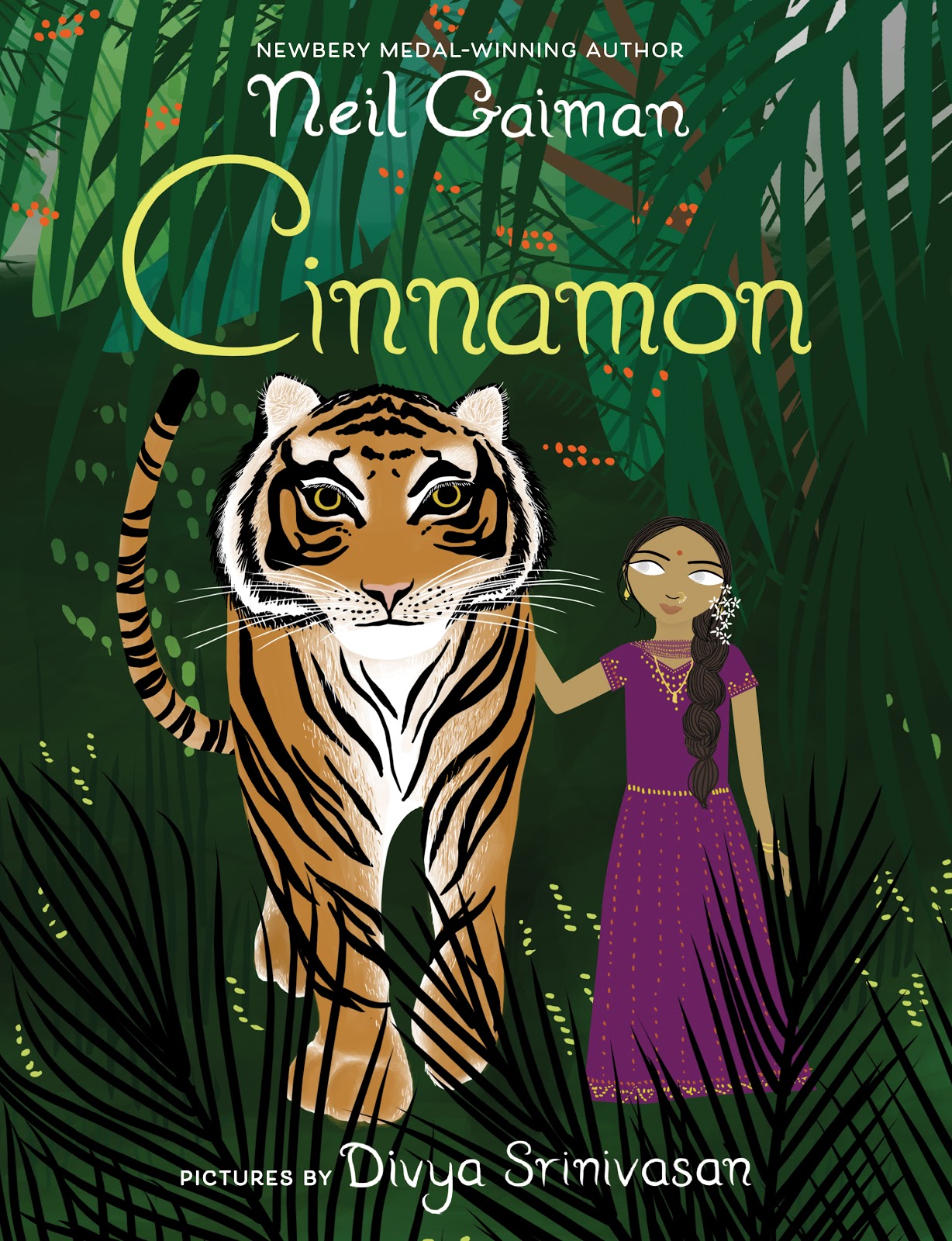
For now, however, we're just going to look briefly at Cinnamon, a short story by Neil Gaiman released in a new edition, illustrated by American artist and author Divya Srinivasan. I picked this up on impulse at my FLBS and for two days Arya refused to let me read it, because it was new and uncertain. Then she agreed, if she could have 'The Clumsy Princess' and The Very Hungry Caterpillar as well, and since then she's asked that the story of a blind princess and the man-eating tiger who sets out to teach her to speak be read to her every night. I call that a success.

(1) Advantages of audiobooks: I would never have pegged the pronunciation of this as An-ah-ander Mee-ah'nee-eye.
(2) Up to younger teen target audience, I mean. Obviously in YA pretty much anything goes, most likely because at that point you're selling purely to the reader and not their parents.
(3) I follow Ben Aaronovich's blog, okay.
(4) More on this when and if I finish the book.
(5) "Does that mean that they poop?" - Arya-Rose, age 4.

Thursday, 4 May 2017

2017 Challenge - The Rose That Grew From Concrete

Poetry Bonus 1

The Rose That Grew From Concrete, by Tupac Shakur

Reason for Reading: This challenge is about broadening my perspective, and the world of hip hop is a mystery to me. Now, this is a collection of poetry and not a novel, so I didn't read it through.

I don't know much about Tupac's life or music. Honestly, I could stand to do a similar challenge for music, because I barely know any music outside of that which utterly pervades western culture. I know only that he was a rapper who came up from nothing and wrote about hardship and violence, and who was killed in a probably gang-related shooting, while still fighting a sexual assault conviction on appeal(1). The latter is especially  noteworthy given his preoccupations in verse with love, rather than lust, friendship and respect. A good proportion of the poems in the collection are dedicated to a specific individual, as a token of friendship or deeper affection. Those later in the book have a darker tone, as those are mostly the ones that talk about his own death, many written months or weeks before he was shot. Even these, however, are introspective and concern his fears or his hopes more than dwelling on the possibility of violence.

There is a simplicity to Tupac's verse. This is not a man steeped in years of exposure to the classics and certainly not someone who obsesses over every single word, which by some lights probably makes him a poor poet, but there's a clarity and a power in that simplicity, rather than naivety. The book is composed with facing pages carrying a printed version of a poem and the original, written in an exercise book in a mix of capitals and lower case print, with crossings out and corrections still in place and never a word if a number would do.

Normally I would hate that, but that's because normally retaining such shorthand would be a sign of sloppy editing, but there is no editing here. These aren't verses carefully curated for publication, but thoughts and feelings preserved in the moment. It's an extraordinary glimpse into a man who was patently more complex than just another dead gangsta; far too complex for me to offer any substantial analysis based on a few readings.

(1) I don't have an opinion on whether he did it or not. He was convicted, but I find it as easy to believe that a black rapper could be wrongly convicted of such a crime as I do that a white businessman could get away with it.

2017 Challenge - Trainspotting

Book 6 (March, Mad People)

Trainspotting, by Irvine Welsh (read by Tam Dean Lin)

Reason for Reading: Set primarily in Leith before its late-80s revival, Trainspotting is as alien to me as anything I've yet approached, and the madness which marks it for March reading (and, yes, I actually read it in late April,) relates to heroin addiction, which is also something alien to me.

The striking thing about comparing novels that have achieved classic status to those which have not and likely will not is the language. Your run of the mill fantasy epics, milporn SF and airport potboilers, even the best of them, use language as a simple medium, a means to convey meaning from the author to the reader, and yes, that's what language is, but... But a great book doesn't just do that; a great book contains language that both conveys meaning and is aesthetically striking in its own right, and this is true no less of the profanity laden, idomatic invective of Trainspotting than of the lyrical flow of One Hundred Years of Solitude. The novel contains more uses of the c-word than any, probably every other book I've ever read, but it is never gratuitous, even when it is. If that makes any sense.

Trainspotting is an angry, hard-to-like book about angry, hard-to-like people being angry and hard to like. It's tough going, but it's supposed to be, and it is the triumph of the novel that even if you don't like its various protagonists, you end up kind of getting them. The shifting narrative voice provides multiple perspectives on each character: Of particular note is the tension between self-styled idealist Renton and self-styled man of the world Sick Boy, and the juxtaposition between Spud's rambling speech and more coherent narrative voice. Franco Begbie is a monster for the ages, and Renton's musings on the group's communal creation of the legend of Begbie the hard man, the stand up mate, is one of the most interesting threads of the book.

This is not a book for the faint-hearted, and it's not a book to be approached casually, especially by those not familiar with the Scots - and specifically Leith - vernacular. I went with an audio book, which probably helped, but it still had to go off when I was tired (and of course could not be listened to in bed for fear that my daughter would wake up, wonder in and start calling people doss c&*$s.) Leith-born actor and professional reader of Irvine Welsh novels Tam Dean Burn runs around every conceivable variation of the Leith accent in the course of the book, infecting the listener's inner monologue with the best variation it can manage - in my case, not very good - and an urge to call people radge bastards. That alone speaks to the power of language.

Did I like it? No, but then it's not a book that wants to be liked. It's a very good book, possibly a great book, but you wouldn't want to hang out with it all the time.